
Goodbye to the eternal spreadsheet: how to reduce compliance time

Goodbye to the eternal spreadsheet: how to reduce compliance time
The spreadsheet era is over
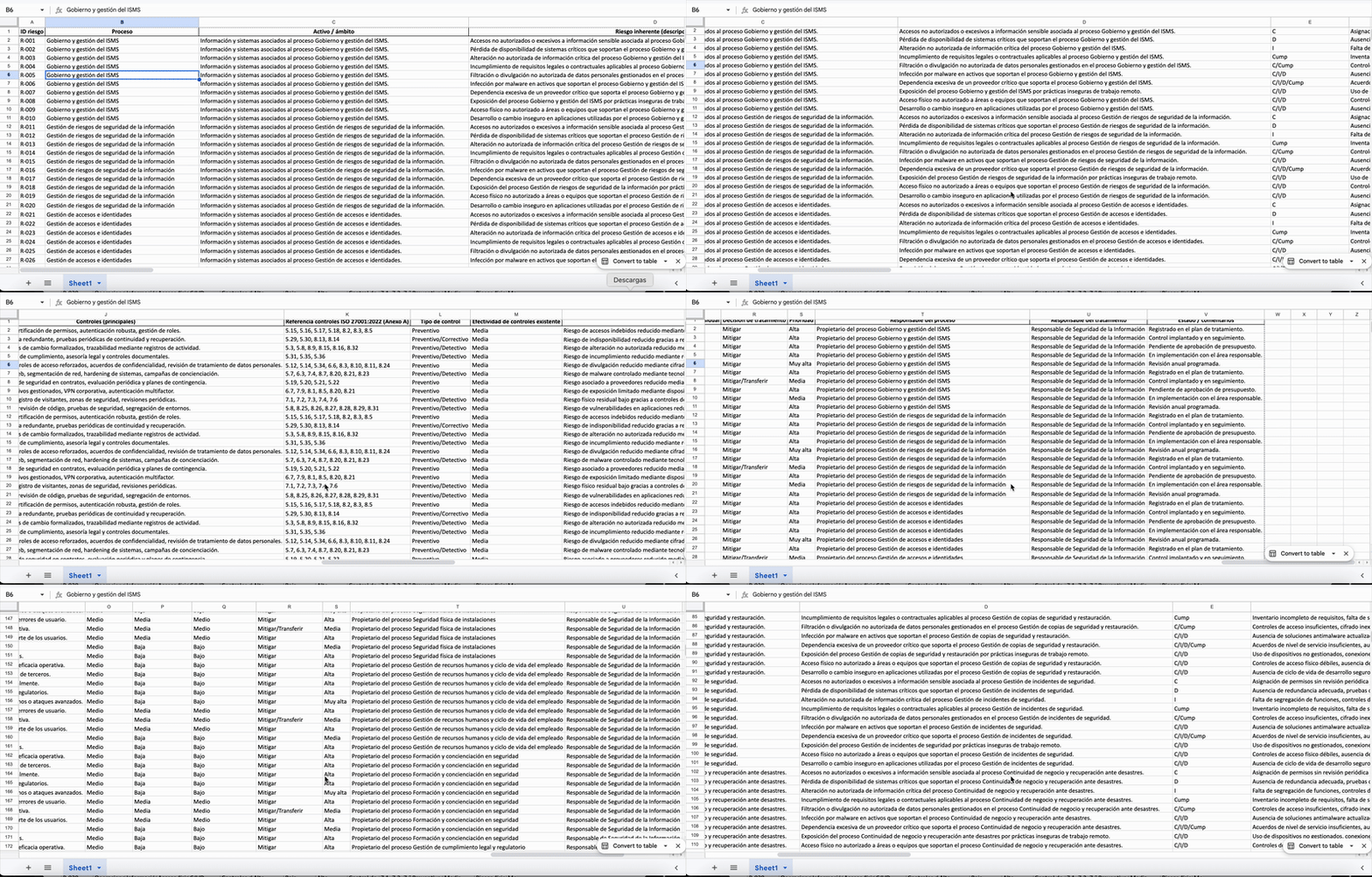
For years, spreadsheets have been the default tool for managing compliance. Risk matrices, control inventories, evidence tracking, audit preparation—everything lived in rows and columns. It worked well enough when regulations were simpler and organizations were smaller. But the world has changed, and the spreadsheet has not changed with it.
Compliance teams today face stricter regulations, more frequent audits, higher stakes, and exponentially more data. What used to take a small team a few hours a week now requires coordination across departments, real-time evidence collection, and the ability to demonstrate compliance at any given moment—not just at the end of the quarter.
If your compliance program still runs on spreadsheets, you are not just behind. You are building on a foundation that cannot scale.
The 4 problems preventing spreadsheets from scaling
1. No single source of truth
When compliance data lives in multiple spreadsheets across different teams and departments, version control becomes a nightmare. Which file is the latest? Who updated what, and when? The answer is often unclear, and the consequences range from duplicated work to contradictory information presented to auditors.
A compliance officer might spend hours reconciling spreadsheets before a board meeting, only to discover that the risk matrix used by the operations team does not match the one maintained by legal. This is not an edge case—it is the norm.
2. Manual updates create lag and errors
Spreadsheets require someone to manually enter, update, and verify data. Every manual step introduces the possibility of error and delay. A control that was completed last week might not be reflected in the spreadsheet until next month. An expired policy might not be flagged until someone happens to check.
In a regulatory environment that increasingly demands continuous compliance—not periodic compliance—this lag is unacceptable.
3. Evidence is disconnected from controls
In a spreadsheet-based system, evidence typically lives in a separate folder structure—shared drives, email attachments, local files. Linking a specific piece of evidence to a specific control for a specific period requires manual cross-referencing. During an audit, this becomes a time-consuming scavenger hunt.
Auditors expect organized, readily accessible evidence. When the compliance team scrambles to locate documents, it does not inspire confidence—regardless of how solid the underlying program might be.
4. Reporting is painful and backward-looking
Generating a meaningful compliance report from spreadsheets is a manual, error-prone process. By the time the report is finished, the data is already stale. Leadership receives a snapshot of the past rather than a view of the present, making it impossible to make informed, timely decisions about risk.
Boards and regulators are asking for more frequent, more granular reporting. Spreadsheets simply cannot deliver this without disproportionate effort.
How Skyward works
Skyward replaces the patchwork of spreadsheets, shared folders, and manual processes with a single, integrated compliance platform. Here is how it addresses each of the problems above:
A single, living source of truth
All compliance data—risks, controls, policies, evidence, tasks—lives in one place. Changes are tracked automatically with full audit trails. Every team member sees the same, current information. There is no need to reconcile conflicting versions because there is only one version.
Automatic evidence capture
Instead of relying on people to remember to upload evidence, Skyward integrates with the tools your organization already uses. Evidence flows into the platform automatically and is linked to the relevant controls and time periods. When an auditor asks for proof, it is already organized and ready.
Real-time risk visibility
Risk scores and control statuses update continuously as new data arrives. The compliance team—and leadership—always has an accurate, current picture of the organization's risk posture. No more quarterly surprises.
AI-powered analysis
Skyward uses artificial intelligence to analyze uploaded evidence, flag anomalies, suggest risk score adjustments, and identify gaps in control coverage. This does not replace human judgment—it augments it, letting compliance professionals focus on interpretation and strategy rather than data entry.
Effortless reporting
Dashboards and reports generate automatically, drawing on live data. Board reports, regulatory submissions, and audit packages can be produced in minutes rather than days. The information is always current, always consistent, and always audit-ready.
Measurable benefits
Organizations that move from spreadsheets to a purpose-built compliance platform consistently report:
- 60-80% reduction in time spent on evidence collection and organization. Automatic capture and linking eliminates the manual scavenger hunt.
- Faster audit preparation. What used to take weeks of scrambling can be done in days or even hours when evidence is already organized and linked.
- Fewer compliance gaps. Continuous monitoring catches issues as they arise rather than during the next scheduled review.
- Better board and regulator communication. Real-time dashboards replace stale quarterly reports, building trust and demonstrating maturity.
- Lower operational risk. With a single source of truth and automatic tracking, the risk of errors, omissions, and outdated information drops dramatically.
Checklist: is it time to move beyond spreadsheets?
Ask yourself these questions. If you answer "yes" to three or more, it is time to make the switch:
- Do you spend more than 5 hours per week maintaining compliance spreadsheets?
- Have you ever presented conflicting data to auditors or leadership because of version issues?
- Does your evidence live in a separate folder structure that requires manual cross-referencing?
- Is your risk matrix updated less than once a quarter?
- Do you dread audit preparation because of the time it takes to organize documentation?
- Have you added new regulations to your scope in the past year without adding headcount?
- Does your board receive compliance reports that are more than two weeks old by the time they are presented?

Frequently asked questions
How long does it take to implement Skyward? Most organizations are up and running within a few weeks. The platform is designed for rapid onboarding, and our team supports the migration of existing data so nothing is lost in the transition.
Do I need to change my compliance framework? No. Skyward is framework-agnostic. Whether you use ISO 27001, SOC 2, the Chilean NCG 461, or a custom internal framework, the platform adapts to your structure.
What happens to my existing spreadsheets? They can be imported into Skyward. Historical data is preserved, and you gain the benefit of having it organized, searchable, and linked to your current controls and risks.
Is my data secure? Skyward is built on enterprise-grade infrastructure with encryption at rest and in transit, role-based access controls, and full audit logging. Security is not an afterthought—it is foundational.
Can I still export data to spreadsheets if I need to? Yes. While the goal is to reduce spreadsheet dependency, Skyward supports data export for teams or stakeholders that need information in traditional formats.
Conclusion
Spreadsheets served compliance well for a long time. But the demands of modern regulation, the pace of business, and the expectations of auditors and boards have outgrown what rows and columns can deliver.
Moving to a purpose-built compliance platform is not about adopting technology for its own sake. It is about giving your compliance team the tools to do their best work—accurately, efficiently, and with confidence. It is about spending less time on data entry and more time on the strategic thinking that actually reduces risk.
The eternal spreadsheet had its moment. It is time to move on.
Enjoyed this article?
Subscribe to get new articles on compliance, risk, and AI.