
Compliance: how (and why) to optimize risk management with AI

Compliance: how (and why) to optimize risk management with AI
Risk management in compliance with AI
If compliance in Chile were a person, it would be a teenager: growing fast, sometimes awkward, full of promise, and constantly testing its limits. While enforcement and awareness have advanced rapidly in recent years, most organizations are still grappling with the same legacy tools they used a decade ago—static spreadsheets, annual audits, and risk matrices that are already outdated by the time they are approved.
That is exactly where artificial intelligence changes the equation. Not as a silver bullet, but as a force multiplier that lets compliance teams do more with less, spot patterns humans would miss, and shift from reactive firefighting to genuine, continuous prevention.
Why traditional risk management falls short
Traditional compliance risk management follows a familiar cycle: identify risks, score them on a matrix, assign controls, review once a year, and repeat. The problems with this approach are well-documented:
- Stale data. A risk matrix created in January rarely reflects the threat landscape in June, let alone December.
- Manual effort. Gathering evidence, cross-referencing policies, and updating scores consumes hundreds of hours per cycle.
- Blind spots. Human reviewers naturally focus on the risks they already know, leaving emerging threats undetected.
- Siloed information. When risk data lives in different spreadsheets across departments, building a unified picture is nearly impossible.
Regulation in Chile has been tightening steadily. The Economic Crimes Law (Ley de Delitos Económicos), updates to the Corporate Criminal Liability Act (Ley 20.393), the Personal Data Protection Bill, and increasing scrutiny from the CMF all demand more granular, more frequent, and more demonstrable risk management. The old playbook simply cannot keep up.

How AI transforms the compliance risk lifecycle
AI does not replace the compliance officer—it amplifies their judgment. Here is how it reshapes each phase of the risk management lifecycle:
1. Risk identification
Machine-learning models can continuously scan internal data sources—transactions, communications metadata, access logs—and external feeds such as regulatory bulletins, judicial rulings, and industry incident databases. Instead of waiting for the annual workshop, risks surface in near real-time.
2. Risk assessment and scoring
Natural-language processing (NLP) can analyze policy documents, audit findings, and incident reports to suggest initial risk scores. AI-driven scoring is not about removing human judgment; it is about giving the compliance team a better starting point and flagging inconsistencies they might overlook.
3. Control mapping and gap analysis
Once risks are scored, AI can cross-reference them against existing controls and policies, highlighting gaps where a risk lacks adequate mitigation or where a control has become redundant. This dramatically reduces the time needed for gap analysis from weeks to hours.
4. Continuous monitoring
Perhaps the most transformative capability: AI enables ongoing surveillance rather than point-in-time checks. Anomaly detection models watch for deviations from expected patterns—unusual transaction volumes, policy access from unexpected locations, sudden changes in vendor behavior—and trigger alerts before incidents escalate.
5. Reporting and board communication
Generating clear, data-driven reports for the board or regulators used to be a painful, manual exercise. AI can automatically compile dashboards, trend analyses, and executive summaries, ensuring that leadership always has an accurate and up-to-date view of the organization's risk posture.
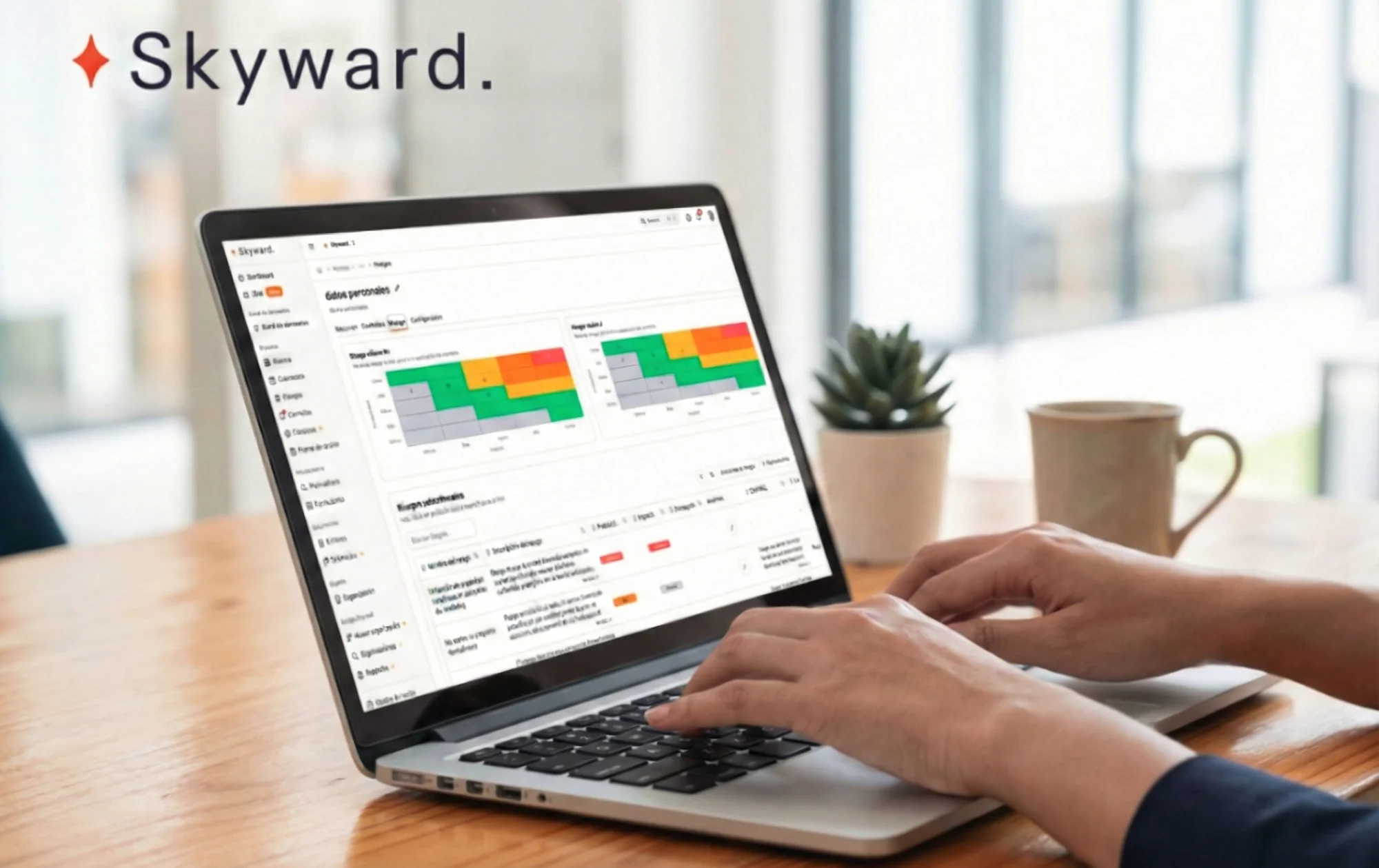
Automating risk matrices: from static to living documents
The risk matrix is the bread and butter of compliance. Yet in most organizations it remains a static artifact—a snapshot frozen at the moment of the last assessment. AI turns the risk matrix into a living document:
- Dynamic scoring. Risk scores update automatically as new data flows in, reflecting changes in the regulatory environment, the organization's operations, or the external threat landscape.
- Version control and audit trails. Every change to a risk score or control mapping is logged with the reasoning behind it, creating a defensible record for regulators.
- Scenario simulation. What happens to the risk profile if the organization enters a new market, launches a new product, or if a key regulation changes? AI-powered simulation tools can model these scenarios in minutes.

Policies and procedures: keeping them alive
Policies are only useful if they are current, accessible, and understood. AI contributes in several ways:
- Automated gap detection. When a new regulation is published, NLP models can compare its requirements against existing policies and flag sections that need updating.
- Version management. Intelligent workflows can route policy updates to the right approvers, track progress, and ensure nothing falls through the cracks.
- Training personalization. Instead of generic annual training, AI can identify which employees need refreshers on specific policies based on their role, department, and recent compliance events.
The challenges of implementing AI in compliance
Adopting AI is not without obstacles. Organizations should be clear-eyed about the challenges:
- Data quality. AI is only as good as the data it ingests. Incomplete, inconsistent, or poorly structured data will produce unreliable outputs.
- Explainability. Regulators increasingly demand that automated decisions be explainable. Black-box models are not sufficient; the system must be able to articulate why a risk was scored a certain way.
- Change management. Compliance teams accustomed to manual processes may resist automation. Success requires clear communication about how AI augments—not replaces—their expertise.
- Cost and integration. Implementing AI tools requires investment in technology, training, and integration with existing systems. A phased approach is usually more realistic than a big-bang deployment.
- Regulatory uncertainty. The rules governing AI in compliance are still evolving. Organizations must stay flexible and monitor developments closely.
Checklist: getting started with AI-powered risk management
For compliance leaders considering AI adoption, here is a practical checklist:
- Audit your data. Assess the quality, completeness, and accessibility of the data your compliance function currently relies on. Fix the foundations before adding intelligence.
- Define clear use cases. Start with one or two high-impact areas—such as continuous monitoring or automated risk scoring—rather than trying to transform everything at once.
- Choose the right tools. Evaluate solutions that integrate with your existing tech stack, offer transparency in their models, and are designed for the regulatory context you operate in.
- Build internal buy-in. Engage compliance officers, legal teams, and senior leadership early. Show how AI saves time and reduces risk rather than threatening jobs.
- Pilot and iterate. Run a limited pilot, measure results against clear KPIs, and iterate before scaling.
- Document everything. Maintain clear records of how AI is used, what data feeds it, and how decisions are reviewed. This is essential for regulatory defensibility.
- Stay current. AI capabilities and regulatory expectations evolve rapidly. Build a habit of continuous learning and periodic reassessment.
Looking ahead
Compliance in Chile—and across Latin America—is at an inflection point. Regulations are becoming more demanding, stakeholders expect more transparency, and the volume of data organizations must manage grows every quarter. AI is not a luxury; it is becoming a necessity for compliance teams that want to move from checkbox exercises to genuine, continuous risk prevention.
The organizations that embrace this shift early will not only be better protected—they will also operate more efficiently, build stronger trust with regulators and partners, and free their compliance professionals to focus on the strategic, high-judgment work that truly matters.
The question is no longer whether AI belongs in compliance. It is how quickly your organization can adopt it—and how thoughtfully you do so.
Enjoyed this article?
Subscribe to get new articles on compliance, risk, and AI.